



Overland Park GMC Tires
Tire Care Information in Olathe, KS
This guide gives you a breakdown of everything you need to know about Overland Park GMC tires, including how to deal with a flat tire, different types of tires you can purchase, and how to tell when your tires are worn.
Dealing with a Flat Tire
If you’re parked and notice that you have a flat tire, run your hand along the back and front of the tire to see if there are any foreign objects in the tread or sidewall. Causes for a flat tire might be an embedded nail or industrial staple. If you don’t notice foreign objects lodged in your tire, you may just be low on air. If your tire is salvageable, you can take it into a service center for repair. If it’s thoroughly torn, you may have to purchase a new tire. If your flat tire occurs while you’re driving, you’ll notice that your car leans toward the side with the flat and doesn’t accelerate as quickly as normal. Pull over onto the shoulder and try to get as far away from oncoming traffic as possible. For extra safety, you can set up traffic cones. Navigation apps like Waze let drivers know when there’s an accident ahead, and police officers normally come help when you’ve been pulled over on the side of the highway for very long.
Changing a Tire
To change a tire, remove the wheel cover (for those with steel wheels), get out your spare tire, secure your vehicle and loosen the lug nuts using a lug wrench. Then, you’ll jack up your vehicle. This can be done with a hydraulic jack (insert the handle and pump up and down) or a scissor jack (take the wrench or rod, insert, and crank). Next, remove the flat tire and lift the spare onto the lug bolts. Keep in mind that tires are heavy! Replace the lug nuts with your wrench. Lower your vehicle by turning the jack in the opposite direction. Tighten your lug nuts as much as possible, then put the wheel cover back on with your hands (no tools required).
Types of Tires
All season tires are made with rubber that ensures flexibility in warm and cold weather. Tread is carefully crafted for optimal stability in snow. The tread also pushes away water to avoid hydroplaning. These tires work best in places that have an average temperature above 45 degrees Fahrenheit. Handling is adequate on wet, dry and light snow covered roads. Heavier snow and ice are still tricky for all season tires to handle though. Winter tires are the better option if you live in an area that frequently has heavy snowfall. Summer tires are ideal for those who live in places where rainfall is frequent.
All-terrain tires mix a little bit of off-road tires and road tires. The treading is tighter than off-road/mud tires, which means they work best for vehicles that will be driven on the road daily and off-road occasionally. All-terrain tires can be used off-road, but you want to avoid getting the wheels packed with mud. These tires perform well on rocky and sandy conditions, get adequate traction in normal road conditions (with more road noise than a street tire), and have increased traction in snowy conditions. These normally have a shorter tread life than street tires, because their rubber is soft. After 40,000 miles, you’ll need to get a new tire put on.
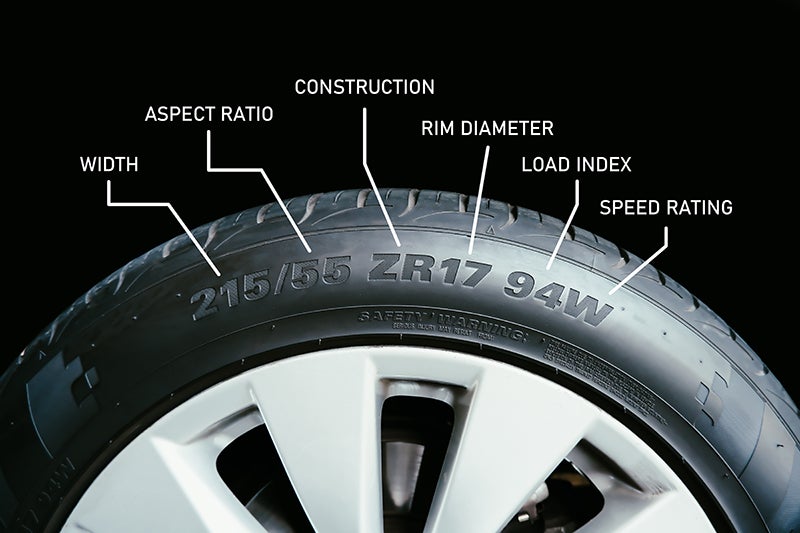
Low-profile tires have a shorter than average sidewall (aspect ratios lower than 50) and tend to handle and perform better than tires with larger aspect ratios. You can purchase larger rims and brakes for your car, making it easier for you to stop in a shorter amount of time. Due to the wider tread, they can grip the road better to increase your stability while driving. The downside to these types of tires is that they can rapidly deflate or take damage from potholes due to their thinner walls. Since the sidewalls don’t absorb as much impact, the ride might be stiffer as well.
Mud-terrain tires are made for the mud, rocky terrain, and deep (unpacked) snow. If you like exploring beyond the beaten path, these are your tires. They can even be used on sand dunes! On paved road, mud-terrain tires don’t perform on the same level as the street or all-terrain tires. This is because of their wider voids and heavy blocked tread. Inclement weather makes this grip even more difficult. Another downside is that mud tires make a lot of road noise on paved surfaces. Mud tires wear out faster than other types, because their wider voids create less rubber contract with the ground.
Performance tires are ideal for sports cars and sport sedans, since they’re made for higher speeds and corner well. These low-profile tires have a large tread block for dry traction/grip but also stiffer sidewalls that can create a less forgiving ride. They have a higher price tag than other tire types—due in large part to their specialized design—and they have a shorter lifespan because of their soft rubber.
Snow tires are constructed from soft rubber that doesn’t harden when the chill moves in. They also have several sipes that aid the tread in biting through the snow. Soft rubber prevents them from hardening when it gets cold, which helps with traction. Typically, snow tires last about 20,000 miles. You’ll be able to tell they’re reaching retirement age when the tread depth falls to 4/32 in. or less. To ensure your snow tires reach retirement age, you should switch them out with your all-season or summer tires when the temperature consistently remains above 45 degrees Fahrenheit. If you leave your snow tires on year-round, the soft rubber won’t provide the same level of traction and the rubber will break down prematurely. There are also plenty of snow tires to choose from—you can go with studded or stud-less, for example. Snow tires with metal studs embedded in the tread are meant to enhance the traction, though they aren’t legal in all states. Tires without studs typically have deeper tread depths to battle the cold weather.
If you own an SUV, you can choose from any type of tire as long as it’s the right size for an SUV. If you plan on just driving on the road, touring and passenger tires are going to be your best bet. For those who want to go off-roading, all-terrain or mud tires are the better option. SUV tires normally have a shorter lifespan than those for a car. Their warrantied for 40,000-70,000 miles. Light truck (LT) tires are an option if you plan on hauling heavier loads. Truck tires have larger sidewalls and heavier load ratings than SUV tires. Light truck tires are designed to haul heavier loads in the bed or on a trailer. They have thicker rubber than passenger tires and are more durable. Passenger truck tires have thinner sidewalls, creating a smoother ride. Truck tires also have shorter warranties (40,000-70,000 miles).
Run-flat tires are great, because they can be driven with no air pressure. This means you don’t have to stop to change the tire—you can continue driving for a short amount of time at a slow pace (under 50 mph). If there’s permanent damage, you may not be able to drive on it. There are two types of run-flat tires: a self-supporting system and a support ring system. Self-supporting run-flat tire systems have reinforced sidewall construction that support the vehicle when air is released. Because of this, the car can continue to operate after air pressure is lost. With the ring run-flat tire system, a ring of hard rubber supports the vehicle’s weight when air is lost. A great benefit to these types of tires is that they help you maintain better control when all the air is lost in conventional tires.
Types of Wear
Toe tire wear occurs when there’s excessive wear on the inner or outer edge of the tire. It’s normally an indication of a wheel alignment issues, and produces a feathered wear pattern along the front tires. Camber tire wear creates uneven wear on one side of the tire tread and is normally caused by camber misalignment. Center tire wear occurs because of over-inflation—the center of the tire wear out more quickly than the sides. Cupping tire wear is caused by worn-out suspension/balance and is indicated by a diagonal scalloping pattern on the tire. Edge tire wear is linked with under-inflation and is indicated by the edge of the tire wearing out more quickly than the center—basically the reverse of cupping tire wear. You can check tire wear with a tread depth gauge, which measures the tread depth from 0 to 19/32 inch. The penny test is done by placing a penny upside down in between the tire tread. If you see the top of Lincoln’s head, your tire needs to be replaced. Tires age based on several variables, including temperature, loading conditions, and inflation pressure maintenance.
Contact Us
If you’re looking for Overland Park GMC tires, Robert Brogden Buick GMC is the dealership for you. Learn about the tire basics, or check to see if your tire type is in stock. We would love to help you with all your tire needs, so contact us!
Sales Hours
| Monday | 8:30AM - 8:00PM |
| Tuesday | 8:30AM - 8:00PM |
| Wednesday | 8:30AM - 8:00PM |
| Thursday | 8:30AM - 8:00PM |
| Friday | 8:30AM - 6:00PM |
| Saturday | 8:30AM - 6:00PM |
| Sunday | Closed |